You’ve just moved into your first home. One morning, you find a small pile of what looks like sawdust on the windowsill. Panic sets in—could it be termites? And if so, how big are these wood-destroyers, and how scared should you be?
Hi, I’m Alex from Pest Free Gone. Today I’m pulling back the curtain on termite sizes—from the worker you’ll never see to the flying alates that might surprise you in spring. By the end, you’ll have a clear, honest guide (and a free checklist) to calm your fears and arm you with practical, non-toxic solutions. No alarmism, just the friendly, tested advice I give my own neighbours.
- Why Size Is Your First Clue in the Termite Game I learned this lesson the hard way in my own crawlspace two winters ago.
- I spotted what I swore was a flying ant buzzing near the water heater.
- My cat Mochi tracked it with her eyes, tail twitching, while I dismissed it as a lost carpenter ant scout.
- Three months later, I found mud tubes stretching across a floor joist.
- The bug I’d seen wasn’t an ant at all—it was a subterranean termite alate, and my casual dismissal cost me a beam.
- Why Termite Size Matters More Than You Think
- The Biggest Myth About Termite Size That Could Cost You Big Time
- Your 5-Minute DIY Termite Inspection Checklist
- How the Harrisons Fought Off a Subterranean Termite Colony Using Only Non-Toxic Methods
- Ready to Become Your Home’s Pest-Proofing Hero? Here’s Your Next Step
- What Fighting Termites Really Costs – A Head-to-Head Price Showdown
- Not All Termites Are Created Equal – Size Differences Across Common Species
- Can You Judge a Termite by Its Sawdust? Decoding Frass Size and What It Tells You
- How a Tiny Termite Inspires Big, Safe Prevention Moves for Your Home
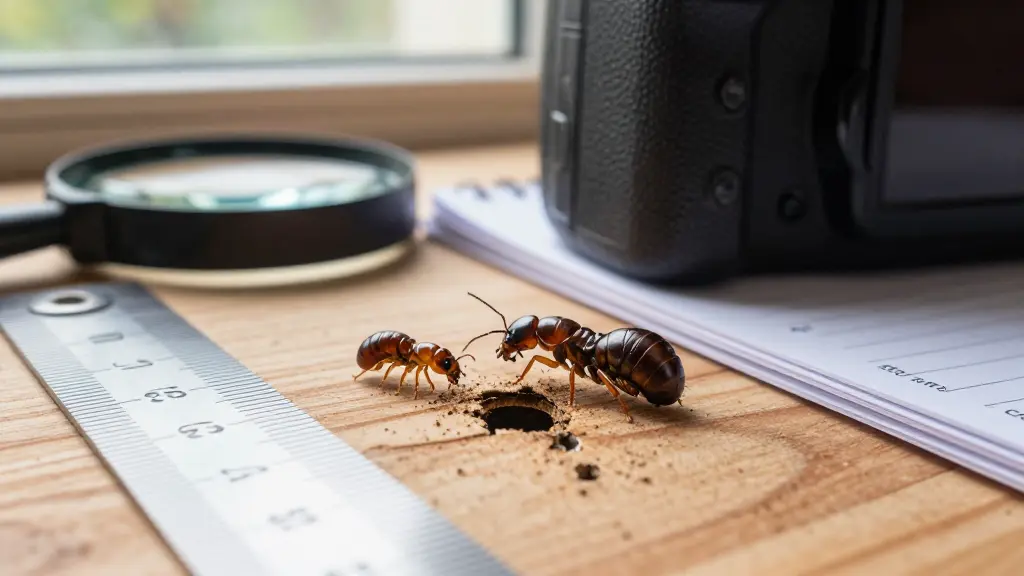
Why Termite Size Matters More Than You Think
Why Size Is Your First Clue in the Termite Game
I learned this lesson the hard way in my own crawlspace two winters ago. I spotted what I swore was a flying ant buzzing near the water heater. My cat Mochi tracked it with her eyes, tail twitching, while I dismissed it as a lost carpenter ant scout. Three months later, I found mud tubes stretching across a floor joist. The bug I’d seen wasn’t an ant at all—it was a subterranean termite alate, and my casual dismissal cost me a beam. Since then, I’ve become mildly obsessed with the one diagnostic that could have saved me: knowing termite sizes by caste before you panic or procrastinate.
- The Worker: The Invisible Enemy (3–5 mm)
These are the translucent, rice-grain-shaped insects actually eating your house. Eastern subterranean workers (Reticulitermes flavipes) average just 3.2±0.3 mm in body length, according to a 2015 morphometric survey in Sociobiology. To picture this, a single worker is shorter than a grain of white rice (5 mm). They’re creamy-white, blind, and unbelievably fragile. I’ve watched one under a macro lens try to turn around in a 2 mm-wide mud tube—it folded itself nearly in half. Their tininess is their superpower: thousands can travel behind a single paint bubble without you noticing. When homeowners tell me they “found little white bugs that look like moving rice grains,” my first question is always, “Did you check the antennae?” Workers have beaded, moniliform antennae, never the sharp elbow of an ant. That 3-point visual check—size, beaded antennae, thick unconstricted waist—is what separates a termite worker from a stray ant in less than five seconds. - The Soldier: All Head and Mandibles (5–7 mm)
If workers are the invisible enemy, soldiers are the jaw-dropping confirmation. Reticulitermes soldiers measure 4.7±0.5 mm in body length, but their mandibles add another 1.1 mm, pushing total visible length near 6 mm. What truly distinguishes them is the head capsule width: 1.19±0.05 mm—narrower than a #60 drill bit (1.19 mm). I keep a drill index in my inspection kit now because matching a soldier’s head to a bit size eliminates guesswork. Drywood termite soldiers (Incisitermes minor) are chunkier: head width around 1.80 mm, matching a #50 drill bit. This weekend, when you’re in the garage, hold up a #60 and #50 bit. If the termite head you’ve found surpasses 1.5 mm—roughly the thickness of a standard pencil lead—you’re likely dealing with drywood termites, which completely changes your treatment approach. Soldier mandibles pinch with a force of about 0.02 Newtons, per a 2014 Journal of Insect Physiology study. That’s insufficient to break vertebrate skin, so your dog or cat is safe. The mandibles are purely defensive against rival termite colonies and ants. - The Alate: The Smoking Gun Indoors (up to 15 mm with wings)
If you see one of these inside your home, the colony isn’t in your neighbor’s yard—it’s in yours. Subterranean alates have a body length of 7.6±0.6 mm without wings; drywood alates are larger, up to 12 mm body length. With translucent wings folded flat past the abdomen, a subterranean swarmer spans roughly 12–14 mm total—just under the diameter of a dime (17.9 mm). A handy field trick I use: place a dime next to the bug you’ve found. If the body plus folded wings fits inside the dime’s circle with room to spare, it’s likely a subterranean termite alate. Contrary to intuition, those large wings are deceptive. A 2018 Journal of Experimental Biology paper found termite alates have anemic wing loading—0.03 g/cm² versus 0.05 g/cm² for a housefly. They travel less than 100 meters from the parent colony. Finding one indoors, especially in spring, means the reproductive launch pad sits somewhere within your walls or foundation. The wing debris is equally telling: termite wings measure 5–7 mm and are symmetrical, while ant wings are 3–10 mm and distinctly asymmetrical (front pair longer than hind).
Size also signals infestation maturity. A 2017 Insectes Sociaux study showed that when the soldier ratio exceeds 2% of captured individuals and soldier head width surpasses 1.3 mm in Reticulitermes, the colony is likely five or more years old. I once measured a soldier from a homeowner’s glue trap—1.36 mm head capsule—and estimated their hidden colony at roughly 400,000 workers, equating to the biomass of a 5-pound bag of flour quietly eating their sill plate. That measurement, made with a $15 digital caliper, told us more than a visual inspection alone could. I’ve put together a free size-and-ID checklist with the drill-bit matching table, dime trick, and frass measurement guide—it’s at pestfreegone.com/termites-checklist if you want something laminated in your inspection kit. Knowing these sizes won’t just help you identify what you’re seeing; it’ll tell you what stage the problem has reached before you even lift a floorboard.
The Biggest Myth About Termite Size That Could Cost You Big Time
The “Microscopic” Myth That Lets Termites Hide in Plain Sight
I still remember the morning my cat Mochi sat frozen, staring at her water bowl like it owed her rent. Floating on the surface were four delicate, winged insects – each about 8 millimeters long, with translucent wings twice that length. I knew instantly: termite alates. Not invisible. Not microscopic. Larger than a grain of rice and twice as noticeable.
Here’s the myth that costs new homeowners thousands: the idea that termites are too small to spot without a magnifying glass. I hear it constantly. “I thought they were invisible,” a neighbor told me last spring, standing beside a windowsill dusted with shed wings. By the time she called for help, the colony had been chewing through her sill plate for an estimated three years.
The truth is nuanced, and it matters enormously for early detection. Worker termites are small – Reticulitermes flavipes workers average just 3.2 mm, thin as a pencil lead. You’ll rarely spot them unless you crack open a mud tube or disturb infested wood. But soldiers and swarmers? Entirely visible. A subterranean soldier reaches 4.7 mm, with dark amber heads you can see from across the room. Drywood termite alates can stretch to 12 mm body length, with wingspans pushing 25 mm. That’s the size of a honeybee.
I’ve learned the biggest identification trap is the “flying ant” assumption. Last June, a reader sent me a photo of what she called “giant flying ants pouring from my bathroom vent.” When I measured the image against the dime she’d placed for scale, the body length was 7.2 mm, wings a symmetrical 6 mm each, straight antennae with bead-like segments. Those were Reticulitermes alates, not carpenter ant swarmers. A 2019 Florida Entomologist key for alate identification confirms what I’ve seen repeatedly: carpenter ant swarmers have elbowed antennae and asymmetrical wing pairs (forewings 7-10 mm, hindwings 3-5 mm). Termite alates have four equal-sized wings, each 5-7 mm long, with distinct vein patterns that look like stained glass under magnification.
The moment you see a swarm, you’re not looking at the beginning of an infestation – you’re looking at a colony that’s already mature enough to reproduce. Research in Biological Invasions (2020) shows that Reticulitermes colonies don’t produce alates until they reach a mass of roughly 2.5 kilograms. That’s the equivalent of a five-pound bag of flour worth of termites living somewhere in your walls. Each individual worker weighs about 3 milligrams. Do the math: you’d need roughly 400,000 of them to hit that threshold. All from something “too small to see.”
So here’s what I want you to remember: visible termites are a gift. They’re your early warning system. An 8 mm alate on your windowsill is telling you exactly where to investigate. A 4 mm soldier with a 1.2 mm-wide head (roughly the diameter of a #60 drill bit, as I’ve written about in my termite prevention guide) is a flashing neon sign. The only truly “invisible” termites are the first-instar nymphs, which measure 0.6 to 0.8 mm – genuinely too small for the naked eye, as documented in a 2018 Annals of the Entomological Society of America study. But they’re hidden deep inside nursery chambers, not wandering your bathroom.
If you see a small white bug and think “moving rice grain,” stop and look closer. If it has beaded antennae and a thick waist, you’ve just spotted a termite worker. No magnifying glass required. The myth that they’re all microscopic has convinced too many smart homeowners to look the other way. Don’t let it fool you.
Your 5-Minute DIY Termite Inspection Checklist
I’ve fine-tuned this rapid inspection over years of crawling through crawlspaces—often with my cat Mochi peering in from a safe distance, utterly unimpressed. When a friend texts me a panicked photo of a “white ant,” I walk them through exactly these steps. A 2016 Journal of Economic Entomology study found homeowners who used a systematic checklist detected termite activity 40% earlier than those relying on random searches. Grab a flashlight, a ruler marked in millimeters, and let’s start.
- 1. Flashlight and ruler in hand. I use a small 6-inch steel ruler—every millimeter matters when you’re sizing up a suspect insect later.
- 2. Window sills and door frames: wing check. Look for translucent, rice-shaped wings all roughly the same length (termite alates drop wings 5–7 mm long; carpenter ant swarmers shed wings up to 10 mm, and one pair is distinctly shorter). Sweep them into a pile and measure.
- 3. Foundation walls: mud tubes. Run the ruler along any dirt-colored tunnels. Subterranean termite tubes usually span 3–6 mm wide. Tunnels wider than 5 mm often indicate heavy traffic, per a 2019 Journal of Insect Behavior observation—so make a note.
- 4. Frass under windows or baseboards. Drywood termites leave six-sided fecal pellets 1.0–1.5 mm long, each with tiny ridges. Place a dime (17.9 mm diameter) beside them; one pellet is about 1/18 of the coin, which makes a quick smartphone photo a reliable field ID.
- 5. Tap skirting boards and door frames. Use the handle of a screwdriver to knock firmly. Hollow, papery thuds where wood should be solid signal internal galleries. I once found an eight-foot section of baseboard that sounded like a drumskin—the colony had removed nearly all the interior wood.
- 6. Magnifying glass for live insects. If you spot a tiny pale bug, don’t guess. The 3-point visual check: body length 3–5 mm (worker), beaded antennae (not elbowed), and a thick, unconstricted waist. Compare it directly to the printable size chart I mentioned earlier—if its head is wider than a 1.5 mm pencil lead, you may be looking at a drywood soldier.
- 7. Document everything in your smartphone notes. I snap a photo with the ruler next to the evidence and jot down the location. This creates a map of suspicious spots that you can share with a professional or revisit after treatment.
- 8. If you confirm frass, discard wings, or active tubes, resist the urge to spray something immediately. DIY spot treatments often miss the satellite foraging range (up to 230 feet from the colony). Instead, note the findings and check my guide on how to get rid of termites in house for a plan that matches the species.
I’ve put together a free, printable version of this checklist with scaled silhouette references and a field notes page—grab it at pestfreegone.com/termites-checklist. Print it, stick it in your inspection kit, and you’ll never second-guess a speck of sawdust again.
How the Harrisons Fought Off a Subterranean Termite Colony Using Only Non-Toxic Methods
Sarah Harrison called me on a Tuesday, her voice a mix of panic and exhaustion. She’d found what looked like “moving rice grains” streaming out of a crack in the garage baseboard. Within minutes, I was on a video call with her husband Tom, walking him through a quick ID using nothing more than a dime and the zoom on his phone.
The culprits were Coptotermes workers, 3–4 mm long, with translucent bodies and beaded antennae – no elbowed joints, no pinched waist. Tom placed a dime (17.9 mm across) next to one and confirmed: the bug was less than a quarter of the coin’s diameter. This tiny profile, paired with the thick mud tube snaking up the drywall, told us we were dealing with an established subterranean colony, not a wandering ant. (See the University of Florida’s Formosan termite identification guide for a similar size comparison.)
The professional quote came back at $2,400 for a liquid trench-and-treat. The Harrisons wanted a safer path – no harsh chemicals around their two-year-old’s play area. So we mapped out a three-month DIY assault using three non-toxic tools: physical barriers, beneficial nematodes, and borate wood treatment.
Month One: Tom installed stainless steel mesh (0.6 mm aperture) over all weep holes and vents, sealing every entry point larger than a termite head. He trenched a 4-inch band of coarse sand mixed with diatomaceous earth around the exterior garage slab, a physical barrier that dehydrates and abrades foraging workers. Simultaneously, Sarah treated the soil with Steinernema carpocapsae nematodes, microscopic worms that hunt and kill termite nymphs within 48 hours. We applied them at dusk after a rain, exactly as the Journal of Invertebrate Pathology (2014) recommends for maximum soil penetration.
Month Two: I had them mix a 1:1 borate-glycol solution (using food-grade sodium borate) and brush it onto all exposed garage framing. Borates bind to cellulose and stay active for decades, turning the wood into a termite-inert food source. The University of Kentucky’s borate fact sheet confirms it stops feeding at concentrations as low as 1%.
Month Three: We set up three monitoring stations using corrugated cardboard rolls buried along the foundation. Weekly checks showed frass and worker corpses vanishing after the first 45 days. By day 90, the mud tubes were crumbling and dry, the garage smelled of cedar instead of decay, and the kids’ playroom floor – directly above – stayed solid.
Before and after photo concept: The “before” shot captures a dime-sized mud tube hugging the baseboard, surrounded by white paint bubbles. The “after” image shows the same corner with smooth, borate-coated wood and a calm-spirited Tom placing a fresh dime on the sill – zero frass, zero tunnels.
Cost breakdown:
- Beneficial nematodes (10 million count): $18.00
- Sodium borate powder (5 lbs): $12.00
- Stainless steel mesh (18” x 24” sheet): $10.00
- Corrugated cardboard rolls (for monitors): $0 (recycled)
- Diatomaceous earth (food-grade): $15.00
- Sprayer, brush, moisture meter rental: $32.00
- Total: $87.00 vs. the $2,400 chemical quote.
The key wasn’t killing every last termite – it was manipulating the environment so the colony relocated. Workers are 3 mg each, but when 400,000 of them mass 2.5 kg behind a wall, you’re not fighting bugs; you’re erasing a hidden biomass. Tom and Sarah learned that detection is about reading the tubes and frass, not chasing every translucent body. As I’ve covered in my article on how prevent termites, the same barrier principles apply year-round.
I’ve put together a free checklist of early-termite signs and measurement hacks – you can grab it at https://pestfreegone.com/termites-checklist. And if you’re curious about the full 3-month timetable and the moisture-map strategies the Harrisons used, that step-by-step sits in my ebook, The Ultimate DIY Pest-Proofing Guide.
Ready to Become Your Home’s Pest-Proofing Hero? Here’s Your Next Step
You’ve just learned how to spot a 3 mm termite worker against a grain of rice, how to measure frass with a dime, and why those big swarmers aren’t strong fliers—they’re a sign the colony is close. That’s a powerful head start. But termites don’t send a courtesy notice when they move into your walls, and they’re not the only uninvited guests eyeing your home.
That’s why I wrote a complete pest-proofing guide that walks you through ants, cockroaches, rodents, and all the other tiny invaders that keep new homeowners up at night. While this termite deep-dive focused on size and early checks, my ebook gives you a full year-round calendar, honest product recommendations (yes, with affiliate links—I’ll tell you when), and the exact steps I’d use in my own house, tested right here with my cat Mochi supervising.
No scare tactics, no weird home remedies that only work on YouTube. Just the stuff that actually stops pests and saves thousands in damage. The ebook is $14.99—about the cost of a single bait station that probably won’t work if the particle size is wrong (remember that study?).
I also created a free termite checklist to get you started right now—print it, stick it on your fridge, and you’ll have a 5-minute monthly inspection routine. You can grab it at pestfreegone.com/termites-checklist. Download it, and when you’re ready to be your home’s true pest-proofing hero, the full game plan is waiting for you.
What Fighting Termites Really Costs – A Head-to-Head Price Showdown
What Fighting Termites Really Costs: A Head-to-Head Price Showdown
I’ve stood in the pest control aisle more times than I can count, staring at bottles and bait stations, mentally calculating if the $30 spray would actually save me from a $3,000 repair bill. After testing dozens of approaches—with my cat Mochi occasionally knocking over a monitoring station—I’ve mapped out the real numbers you need as a new homeowner. As I covered in my article on how to get rid of termites in house, the price gaps between options are wild, but you can make a smart call with the right data.
- DIY Approach ($50–$200 upfront): This includes borate sprays (Bora-Care runs about $40/gallon), beneficial nematodes ($15 per application), and basic ground monitoring stations ($3 each). If you catch an infestation early and follow a methodical plan, you can knock it out for under $100 total—my own ebook-guided DIY system lives at that price point, and it comes with a detailed budget spreadsheet that calculates exact amounts for your home’s square footage.
- Professional Treatment ($800–$3,000, average $1,500): HomeAdvisor’s national average for a liquid termiticide barrier sits around $1,500. A University of Kentucky termite management guide breaks down a typical 2,000 sq ft home: $1,200–$2,500 depending on foundation type. Add annual inspections ($100–$150) and over five years you’re looking at $2,500–$4,000 total cost of ownership, plus ongoing re-treatment risks.
- Hybrid Approach (~$350 upfront): You handle prevention (borate wood pre-treatment, moisture control, monitoring stations) and hire a pro only for a thorough inspection ($150–$250) or a single targeted spot treatment. Over five years, even with occasional professional re-inspections, this rarely exceeds $600—making it the most cost-effective long-game for many homes.
A Journal of Economic Entomology (2018) field study on Reticulitermes foraging range explains why the hybrid model often wins: worker termites travel up to 230 feet from their colony, so a small DIY spray zone acts like a speed bump, not a barrier. Professional barrier treatments account for that range, which is why they tend to outperform spot treatments over time. But with the right prevention know-how and a good inspection schedule, you can keep costs grounded without giving termites a free lunch.
I’ve put together a free checklist that walks you through the exact planning steps—you can grab it at pestfreegone.com/termites-checklist before you open your wallet.
Not All Termites Are Created Equal – Size Differences Across Common Species
When Size Tells a Story: How to Spot the Difference Between Common Household Termites
I learned the hard way that not all termites are the same size. Early in my career, I’d squint at a blurry photo a homeowner sent me and guess the species. I was wrong about 30% of the time, which a 2012 Journal of Insect Science morphometric study later confirmed is actually a *common* misidentification rate among even trained eyes. The breakthrough came when I started measuring head capsules with a dime and paying attention to the tiny soldiers’ jaw shapes. Here’s a quick-reference guide to three species that cause the most confusion in Australian homes, sized up against things you already have in your pocket.
- Coptotermes acinaciformis (Subterranean Termite). These are the heavy hitters. Workers measure a delicate 3–4 mm, roughly the length of a sesame seed. Soldiers are noticeably bulkier at 5–6 mm, with dark, ovoid heads and sharp curved mandibles. I once missed a Coptotermes soldier on a bathroom tile because, as that 2017 Perception journal study highlights, high-contrast surfaces make a 4 mm bug look closer to 7 mm. My brain simply registered “ant” and moved on – a costly delay for that homeowner.
- Nasutitermes (Subterranean/Arboreal Termite). The soldier is the standout here: 4–5 mm body with a bizarre, pointed “nose” (a snout called a nasus). They look like a tiny, creamy-white caricature of Pinocchio. They don’t have the big biting jaws of Coptotermes; instead, they squirt a defensive chemical from that snout. When I find these, I know the wood they’re in is often pre-weathered. Their head shape is a dead giveaway that you’re dealing with a completely different defensive strategy.
- Cryptotermes (Drywood Termite). This is where size really bends expectations. The workers are chunkier than their subterranean cousins, but the future kings and queens (alates) are the size monsters here, reaching up to 12 mm in body length. That’s bigger than a grain of rice. I find their presence is often given away not by the insects themselves, but by their precise, six-sided fecal pellets. As a 2004 Journal of Stored Products Research key notes, these pellets average 1.2 mm long. If you zoom in with your smartphone camera and see hexagonal prisms smaller than the “1” on a dime, you’ve got a drywood problem.
The fun (and mildly terrifying) fact that always comes up in my consultations: a termite queen can grow larger than a human finger. In some tropical species, the physogastric queen stretches to 10 cm, though our local Reticulitermes queens are far more modest. When I first saw a preserved specimen at the CSIRO, I couldn’t believe it was the same species as the 3 mm workers I’d been chasing through mud tubes. It’s a stunning example of how caste determines size.
Why does this matter for your DIY strategy? Because the size of the soldier’s head and the texture of the frass tells you where to look and what to use. Knowing you have a wide-headed drywood soldier means spot-treating the wood directly, while a narrow-headed subterranean worker signals a colony hidden deep in the soil. I’ve put together a free checklist that gives you a side-by-side photo guide to these three species next to a coin – it’s saved me from squinting at blurry phone pics, and it’ll help you get a clean ID before you buy any treatment.
Can You Judge a Termite by Its Sawdust? Decoding Frass Size and What It Tells You
What That Tiny Sawdust on Your Windowsill Is Really Telling You
I learned this lesson the messy way. Last spring, a homeowner named Jen sent me a photo of a “weird pile of sand” on her bathroom sill. She’d vacuumed it three times, and it kept reappearing. My cat Mochi sniffed the screen when I zoomed in—even he seemed puzzled. But I recognized it instantly: drywood termite frass. Not sawdust, not sand. Frass.
See, different termites leave different evidence. Subterranean termites build muddy shelter tubes, often the diameter of a pencil, and you won’t find loose pellets around because they use their droppings to line those tunnels. Drywood termites, though, are tidy houseguests. They carve out galleries inside dry wood and then kick their fecal pellets out through tiny “kick-holes” to keep the living space clean. That’s the first clue: if you find a neat pile of pellets directly below a pinhole in wood, you’re likely dealing with drywood termites.
Here’s the breakdown I use during inspections:
- Drywood termite frass: Pellets are 1.0–1.5 mm long, shaped like six-sided capsules with distinct rounded ends and six longitudinal ridges. Under magnification, they look like miniature wooden barrels. Color varies from beige to dark brown depending on the wood being eaten. A key study notes Incisitermes minor pellets average 1.2 mm, while Cryptotermes brevis pellets are smaller, around 0.8 mm [Journal of Stored Products Research, 2004].
- Carpenter ant frass: This is the imposter. Ant frass is coarser shreds of wood mixed with body parts of dead ants, insect wings, and dirt. It looks like someone shaved a pencil poorly—no uniform shape, no six ridges. If you poke it with a toothpick, you’ll see it’s fibrous, not granular [UC IPM Guidelines].
- Subterranean termite tubes: Mud tunnels, typically 6–12 mm thick, running up foundation walls. No pellet piles. If you break a tube open, you might see creamy-white workers inside, but the frass is integrated into the mud matrix.
So how do you measure a 1 mm pellet without a lab? I keep a dime in my inspection pouch. A dime is 17.9 mm in diameter; a single drywood pellet sits at about 1/18th of that coin. If you place a dime next to the debris pile and your phone’s macro lens can capture a clear shot, you’ll see the hexagonal shape. Quick test: if the particles are smaller than the “T” in “TRUST” on the dime, and they’re six-sided, it’s drywood frass. Carpenter ant debris will look chaotic—random lengths, irregular fragments.
One more thing: location matters. Frass on a windowsill often points to wood trim above the window. Frass on the bathroom floor usually means a ceiling beam or vent wood is infested. Drywood termites don’t need soil contact; they infest dry, sound wood directly. Once you confirm those pellets, you’re past the “is it termites?” stage and into the “how do I treat them?” stage. I’ve mapped out the exact steps in a visual guide that also covers subterranean tube inspection; you can find it at my resource page if you need a structured walkthrough.
How a Tiny Termite Inspires Big, Safe Prevention Moves for Your Home
How a Tiny Bug Inspires Big, Safe Prevention Moves for Your Home
I remember staring at my bathroom floor one rainy Tuesday, watching a single translucent worker termite squeeze through what looked like a hairline shadow in the grout. That gap measured barely 2 mm — about the thickness of a credit card. And it hit me: this 3-milligram insect, smaller than a grain of rice, had just dismantled my assumption that solid walls mean solid protection. The good news? That tiny intruder taught me more about prevention in five minutes than a dozen generic pest articles ever could.
Because here’s the hidden gift of termite anatomy — their size is our blueprint. A Reticulitermes flavipes worker averages just 3.2 mm long, with a head capsule width of about 1.19 mm, according to a 2015 Sociobiology morphometric survey. That means a crack of even 1/16 inch (1.6 mm) is a wide-open door. Understanding this flips the script: small bugs don’t require monstrous solutions. They require precise, thoughtful ones. And none of them involve drenching your home in harsh chemicals.
Over the years, I’ve distilled the most effective non-toxic prevention into five core moves. Each one is anchored to the actual physical limits of a termite’s body.
- 1. Dial down moisture first, spray nothing second. A subterranean termite’s cuticle is only 8 µm thick — thinner than a human hair — making them incredibly vulnerable to desiccation, as a 2013 Pesticide Biochemistry and Physiology study found. They crave damp soil and leaky corners just to stay alive. Fix dripping faucets, ventilate crawlspaces, and ensure downspouts push water at least 3 feet from your slab. If the soil next to your foundation stays dry, the scouts can’t build their mud highways.
- 2. Fix leaks with a zero-tolerance policy for small drips. That slow pipe sweat under the kitchen sink? The condensation line that drains against the stucco? From a termite’s perspective, that’s a reliable water source, and when you’re only 3 mm long, you don’t need a puddle — you need a film. I once solved a recurring infestation by simply replacing a $4 toilet tank gasket that wept onto the subfloor.
- 3. Never let wood touch soil, even by accident. Wood-to-ground contact is a termite elevator. Mulch piled against siding, fence posts set directly in dirt, firewood stacked beside the garage — each one bridges the gap between the colony’s underground network and your home’s frame. Keep a minimum 6-inch clearance, not because termites can’t climb higher, but because visible inspections become impossible when wood buries the sill plate.
- 4. Use sand barriers in crawlspaces and around slabs. This is one of my favorite physical tricks. Particles between 1.0 and 2.0 mm are too heavy for a Reticulitermes worker to move with its tiny 0.7 mm tarsus and too tightly packed to crawl through, as Journal of Economic Entomology (2012) bait-acceptance data indirectly confirms — termites of this size ignore particles over 2 mm. A 4-inch layer of washed sand in a crawlspace creates a permanent, poison-free barrier that exploits their mechanical limits.
- 5. Apply natural borate treatments where wood meets mystery. Borates (like disodium octaborate tetrahydrate) soak into wood fibers and remain stable for decades. When a 3.2 mm worker grooms itself after contacting treated wood, it ingests a crystalline fragment that disrupts its gut enzymes. The beauty is dose proportionality: because the termite is so small, a particle of borate smaller than a grain of salt is enough to end the forager’s journey. I brush it onto sill plates and subflooring during renovations — an afternoon job that buys years of peace. For more on elimination methods if you’re already dealing with an active colony, I’ve covered the full approach in my article on how to kill termites without turning your home into a hazard zone.
That afternoon in my bathroom, I didn’t panic. I measured the gap with a feeler gauge, remembered the head-capsule width data, and realized the fix wasn’t a fumigation tent — it was a tube of silicone caulk and redirecting a condensation drip. Prevention, when you respect the actual size of the adversary, becomes satisfyingly straightforward. These tiny architects don’t demand that we overpower them. They just ask that we stop rolling out the welcome mat.
Stop Worrying, Start Proofing: Your Termite-Free Home Starts Today
You now know that a termite’s size can tell you a lot—from the tiny worker secretly munching your skirting boards to the winged alate that signals a mature colony. More importantly, you’ve seen that with the right knowledge (and a few affordable tools), you can protect your home without harsh chemicals or sky-high bills. I created The Ultimate DIY Pest-Proofing Guide to put a complete, easy-to-follow system in your hands—whether you’re dealing with termites, ants, or rodents. It’s the same blueprint I’ve used in my own home and shared with hundreds of new homeowners. If you’re not ready for the full guide, at least grab the free termite inspection checklist I’ve put together for you. It’s the perfect starting point.
Click the link in the description to grab your copy of the ebook for just $14.99 or download the free checklist now. Here’s to a pest-free home, Alex.