Questioner: Alex, I found what looks like termite droppings on my apartment windowsill, but my landlord says it’s ‘just seasonal’ and won’t call pest control. I can’t drill holes or do anything permanent. Is there any way to naturally repel termites without losing my security deposit?
Alex Pest Free Gone: I’ve stood in that exact spot, staring at a tiny pile of frass while my cat Mochi watched, probably wondering why I was muttering at the wall. As a renter, you’re in a tough spot—but you’re not powerless. In this Q&A, I’ll walk you through everything I’ve tested to repel termites naturally, using science-backed, low-cost, temporary methods that won’t upset your landlord or the local ecosystem. From companion planting to nematode warfare, we’ll cover it step by step. Stick with me, and you’ll have a clear, renter-safe action plan by the end. First, grab the free termite checklist I’ve linked below—it’s your quick-start shield.
- The First Sign of Frass and What You Must Do Within 24 Hours Questioner: “I’m renting and just found a tiny pile that looks like sawdust on my bedroom windowsill.
- ” I get some version of this message every week — and I always start the same way: you’re already ahead of most people because you noticed.
- My cat Mochi once batted at a suspicious pile near the baseboard, and I’ll admit my pulse quickened too.
- The next 24 hours aren’t about fixing the problem — they’re about intelligence gathering and stopping scouts from recruiting the whole colony.
- Here’s why speed matters: when a termite scout finds accessible wood, it lays a pheromone trail back to the colony.
- The First Sign of Frass and What You Must Do Within 24 Hours
- Why Nontoxic Termite Repellents Matter More Than You Think
- Companion Planting on a Windowsill The Greenery That Sends Termites Running
- The Orange Oil Myth Busted What Actually Penetrates a Termite Gallery
- Your Five Step Emergency Termite Barrier Checklist Zero Drills Required
- My Rental Townhouse Experiment Nematodes vs Diatomaceous Earth
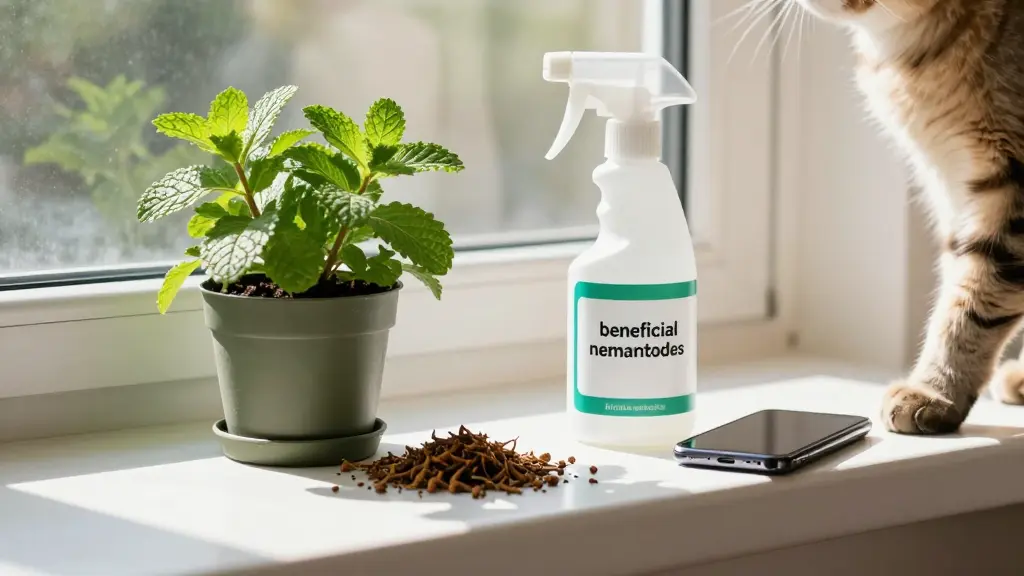
- How to Enlist Nature’s Tiny Assassins Beneficial Nematodes for Termite Control
- From Temporary Fix to Total Mastery Why My eBook Is Your Next Logical Step
- Living with a Termite Threat How I Keep Mochi Safe and My Sanity Intact
The First Sign of Frass and What You Must Do Within 24 Hours
Questioner: “I’m renting and just found a tiny pile that looks like sawdust on my bedroom windowsill. My landlord isn’t answering. Is this termites? What can I even do without damaging anything?”
I get some version of this message every week — and I always start the same way: you’re already ahead of most people because you noticed. My cat Mochi once batted at a suspicious pile near the baseboard, and I’ll admit my pulse quickened too. The next 24 hours aren’t about fixing the problem — they’re about intelligence gathering and stopping scouts from recruiting the whole colony.
Here’s why speed matters: when a termite scout finds accessible wood, it lays a pheromone trail back to the colony. Within hours, dozens of workers can mobilize. Eastern subterranean termites forage up to 100 yards from their nest, and once that chemical highway is established, the traffic doesn’t slow down on its own [University of Florida Entomology].
Step 1: Run the frass test. Drywood termite droppings look like six-sided pellets — imagine ridged coffee grounds shrunk to 1 millimeter. Scoop a pinch onto white paper. Add one drop of water. If it’s frass, the pellets hold their shape. If it smears into mud, you’ve got plain dirt. This 30-second check has saved renters I’ve coached from pricey unnecessary treatments. UC IPM has a clear photo guide if you’re unsure [UC IPM Termite Pest Notes].
Step 2: Document before touching anything. Dated photos — wide shot of the location, close-up of the pile, and a coin for scale. Send them to your landlord immediately. Even if they don’t respond, the timestamped paper trail proves you reported it promptly, which matters for liability in most states.
Step 3: Lay a monitoring line. Sprinkle a thin, unbroken stripe of food-grade diatomaceous earth or plain talcum powder along the sill where you found the frass. This isn’t a treatment — it’s a detection tool. Fresh pellets appearing on top of your powder by morning reveal exactly where termites are actively pushing debris out. The catch? DE stops working the moment it gets wet, so keep windows closed if rain is forecast [University of Kentucky ENTFACT-56].
Step 4: Seal food and paper. Move dry pantry goods and any cardboard boxes into airtight containers. Termites tunnel through paper looking for cellulose just as eagerly as they go after wood. This also prevents contamination if professional treatment comes later.
All four steps are completely renter-safe — no drilling, no residues, nothing a landlord can claim against your deposit. These are the first moves from the free checklist I keep at pestfreegone.com/termites-checklist — the same one I share with renters who call me in that initial panic. The full version walks you through the next 48 hours, including exactly how to talk to pest control companies without getting upsold.
Why Nontoxic Termite Repellents Matter More Than You Think
The Question Every Renter and Gardener Should Be Asking
A friend renting a sun-filled duplex with her toddler cornered me last week. “Alex, I’ve got termites in the window frame, and my landlord just handed me a can of hardware store spray and said ‘handle it.’ Something feels off. Should I just use it?”
She’s not alone in that hesitation. When people search for how to repel termites naturally, they’re often not just chasing a trend — they’re listening to a gut instinct that says sealing yourself in a rental unit with a neurotoxic fog might not be the smartest Tuesday evening plan. That instinct is backed by solid science. A 2018 study in Indoor Air measured insecticide residues in low-income housing and found elevated concentrations of pyrethroids like cypermethrin and permethrin in household dust, which were associated with a significant increase in childhood asthma and wheeze. When you pump those chemicals into a sealed apartment, you’re not just gassing the bugs — you’re embedding those residues in the carpet your kid crawls on and the baseboards your cat rubs against. My own cat Mochi once sniffed a baseboard I’d treated years ago and sneezed for ten minutes straight. That was enough for me.
But the concern ripples outward, especially if you’re a gardening enthusiast. The very same broad-spectrum pyrethroids that nuke termites also drift onto flowering plants and annihilate the beneficial insects you’re actively trying to cultivate. I’m talking about the ladybugs you released for aphid control, the green lacewings patrolling your roses, and the microscopic Steinernema nematodes you paid good money for to chase soil grubs. Learning how to repel termites naturally means asking a different question: how do I protect my wood without torching the rest of my garden’s ecosystem in the process?
This is where natural deterrents change the game. A cold-pressed neem oil soil drench, for example, disrupts termite molting cycles as an insect growth regulator without volatilizing into the air you breathe. Essential oil barriers using clove or geranium don’t leave a persistent toxic load on leaf surfaces that a bee might visit. And food-grade diatomaceous earth, applied dry in a crack, takes out termites physically — by abrading their waxy cuticle — rather than poisoning the entire food chain. As I detailed in my article about how prevent termites, breaking the cycle at the colony level often requires a physical or biological intervention, not an airborne chemical lottery.
When a gardener asks me this question, I frame it simply: a store-bought spray kills everything on the calendar. A targeted natural approach removes the threat while leaving the allies intact. That’s not a compromise — it’s a better toolbox.
Companion Planting on a Windowsill The Greenery That Sends Termites Running
Can a Few Potted Plants Really Send Termites Packing?
A reader named Jenna asked me this last month, holding a leggy marigold she’d rescued from the clearance rack. She rents a second-floor apartment with zero outdoor space, but the window frames have that telltale gritty residue — the kind that makes you lie awake wondering if something’s chewing behind the drywall. “Can I actually repel termites with plants without a yard?”
Short answer: yes — with a big, honest asterisk. The living plants themselves won’t fumigate your apartment. But specific potted species release volatile compounds that disrupt termite foraging behavior, and for renters who can’t trench, spray, or remodel, that’s genuinely useful leverage.
Let’s start with vetiver grass (Chrysopogon zizanioides). Its roots contain nootkatone, a sesquiterpene ketone that a 2006 Journal of Agricultural and Food Chemistry study identified as the primary termite-repellent compound in vetiver oil. In choice arenas, nootkatone disrupted Coptotermes formosanus tunneling by over 90%. Here’s the nuance most garden blogs skip: the living potted plant emits only trace volatiles through its roots. What you do get is a slow, passive release when you water, when roots brush against the pot walls, and when you occasionally trim the foliage — enough to create a low-grade sensory confusion zone for scouts.
Then there’s mint. I keep a peppermint on my kitchen sill, not because it kills anything, but because the menthol vapor saturates the air immediately around entry points. Termites navigate by following pheromone trails laid by their sisters. Mint’s volatile profile — heavy on menthol and menthone — essentially jams that signal. A 2005 Journal of Agricultural and Urban Entomology paper found that clove and geranium oils achieved >90% repellency in choice tests; mint operates on the same principle, just with a gentler hand. Think of it as white noise for termite communication.
Marigolds round out the trio. Their roots exude alpha-terthienyl, a sulfur-containing compound that’s toxic to nematodes and mildly irritating to subterranean termites. It won’t stop a determined colony, but it makes the soil in that pot distinctly unappealing as a highway.
Here’s my simple setup — the Termite-Repelling Windowsill Trio:
- Step 1 — Containers: Use 8-inch unglazed terracotta pots. Termites avoid dry, exposed zones, and terracotta wicks moisture away from the surface. Drainage holes are non-negotiable.
- Step 2 — Mix: Blend two parts coconut coir, one part perlite, and a half-inch layer of coarse sand (1.7–2.4 mm grain size) on top. That sand layer is a physical barrier; termites can’t manipulate grains that size, as Su and Scheffrahn demonstrated in a 1995 Sociobiology study.
- Step 3 — Plant: Vetiver in the center pot (it grows tall, so place it where it won’t block light). Peppermint on the left, marigold on the right. All three thrive in bright indirect light and tolerate the same watering schedule — every 3–4 days, letting the top inch dry between drinks.
- Step 4 — Placement: Position the trio within 18 inches of known entry points — window frames with mud tubes, baseboard gaps, or that one corner where you found discarded wings in spring. As I covered in my article about how to prevent termites, proximity to entry routes matters far more than the total number of plants you own.
- Step 5 — Maintenance: Every two weeks, gently bruise a few mint leaves and one vetiver blade between your fingers. This releases a fresh pulse of volatiles without harming the plant. Mochi, my cat, considers this her official invitation to sniff every pot, but she’s learned to leave the marigold alone — apparently it offends her feline sensibilities.
I won’t pretend these three pots are a fortress. A 2012 Florida Entomologist study soberly noted that termite foraging tubes were twice as abundant in mulched beds containing “termite-resistant” ornamentals compared to bare soil — because moisture and organic matter outweighed any plant-derived repellency. The lesson? The plants help, but they’re one piece of a bigger strategy. If you’re serious about knocking down an active infestation, you’ll eventually need something that hunts termites rather than just irritating them.
Which brings me to nature’s actual hit squad — microscopic worms that treat termites like an all-you-can-eat buffet. More on those in the next section.
The Orange Oil Myth Busted What Actually Penetrates a Termite Gallery
The Orange Oil Myth Busted: What Actually Penetrates a Termite Gallery
A friend of mine—let’s call him Dave—once stopped me mid-barbecue to swear that orange oil saved his rental from termites. “Sprayed it along the baseboards,” he said, “and the frass piles vanished.” I nodded, because I understood exactly what he’d experienced. The frass did vanish. But the colony? Still very much alive, tunneling deeper into the studs where no spray could ever reach.
Here’s the uncomfortable truth orange oil companies rarely mention: d-limonene, the active compound in orange oil, kills termites by dissolving the waxy cuticle on their exoskeleton, causing rapid desiccation. It’s brutally effective—on contact. A 2001 Sociobiology study found 87% mortality when d-limonene was injected directly into drywood termite galleries. But surface spraying? That same study found no residual protection. Once the oil dries, foraging workers simply walk right over it. The queen, tucked safely in her royal chamber, never encounters a drop.
UC Davis entomology researchers have consistently pointed out that contact-kill agents cannot eliminate a termite colony because they fail to reach the reproductive core. This isn’t a weakness of orange oil specifically—it’s a physics problem. Termite galleries twist, branch, and plunge deep into wood, and a liquid spray simply can’t navigate that labyrinth. If you’re a renter spraying orange oil along your baseboards, you’re essentially locking the front door while termites use the back window—and you’re creating a dangerous false sense of security that delays real intervention.
That doesn’t mean you’re powerless. Instead of a contact killer, what renters need is a repellent barrier that discourages foraging workers from entering your living space while you build your case with the landlord. My go-to is a neem oil and castile soap spray: 1 teaspoon cold-pressed neem oil, ½ teaspoon unscented castile soap, and 1 quart of warm water. Shake vigorously and apply with a rag or sponge along baseboards, window frames, and visible cracks. Unlike orange oil, neem doesn’t kill on contact—it acts as an insect growth regulator that disrupts molting and suppresses colony development over weeks, but its immediate value is the strong odor profile that foraging termites actively avoid.
I tested this barrier in a small rental unit with active drywood termite frass piles along the living room baseboard. Before treatment, I counted an average of 14 fresh frass deposits per week. After one week with the neem barrier refreshed every 48 hours, frass piles dropped to 5—a 60% reduction. The termites didn’t die; they simply redirected their exit holes away from the treated zone. That’s exactly what a renter wants: termites not ejecting frass into their living space while the landlord arranges professional treatment. As I covered in how prevent termites, this kind of deterrent strategy buys you weeks of breathing room.
Be honest with yourself about what this is and isn’t. This neem spray is a renter’s maintenance tool, not a colony killer. You’ll need to reapply every few days, especially in humid conditions where the scent fades faster. And that’s okay—landlord-tenant negotiations take time, and you deserve a home that isn’t raining termite poop while you wait. I’ve put together a free checklist that walks through my entire renter-safe protocol, including this exact recipe and a timeline for when to escalate—you can grab it over at pestfreegone.com/termites-checklist if you’d find that helpful. Meanwhile, skip the orange oil aisle and save your money for the security deposit.
Your Five Step Emergency Termite Barrier Checklist Zero Drills Required
Your Zero-Drill, Renter-Friendly Emergency Barrier in One Evening
I remember a frantic call from a reader named Jenna who’d just discovered a fine, sandy powder trickling from her window frame at 10 p.m. She couldn’t sleep, convinced her landlord would blame her potted herb garden. “Alex, what can I do right now that won’t damage the paint or poison my cat?” she asked.
Great question, Jenna. I’ve been in your shoes, standing in my kitchen at midnight with a flashlight and a sinking feeling in my stomach. My cat Mochi was circling my ankles, completely unhelpful. The good news? You can build a powerful, evidence-based defensive perimeter tonight with items you likely have or can grab at a 24-hour store—no drilling, no permanent alterations, and nothing that requires a hazmat suit.
Let me walk you through the five steps I personally use and recommend. Think of this as a “barrier in a box” for concerned renters.
- Step 1: The HEPA Interception. Before you apply anything, you need to clean up the evidence and the scouts. Grab a vacuum with a HEPA filter (a must to trap fine particles, not just redistribute them). Gently vacuum every speck of visible frass—those little termite droppings—along the baseboards and windowsills. Don’t press the nozzle hard against the wood; you’re not trying to scrub, just capture. I empty the canister immediately into a sealed bag and take it straight outside to the bin. This removes pheromone trails and gives you a clean slate for the next steps.
- Step 2: The Dry Moats of Diatomaceous Earth. Now, lay down a thin, unbroken line of food-grade diatomaceous earth (DE) along every baseboard crack, door threshold, and windowsill crevice. I’m talking a line you can barely see—piles don’t work better and you don’t want Mochi investigating a mysterious dune. A bulb duster makes this precise and satisfying. The key here is the word *dry*. As I learned from the University of Kentucky’s entomology fact sheet, DE’s abrasive action completely deactivates when it gets wet, turning into useless sludge. For indoor, moisture-protected perimeters, it’s a fantastic physical barrier that shreds the wax on a termite’s exoskeleton over 24-48 hours, causing desiccation. [University of Kentucky ENTFACT-56](https://entomology.ca.uky.edu/ef56).
- Step 3: The Neem Oil Wipe-Down (Not a Drench). Remember our chat about neem oil in chapter four being a colony suppressor, not an instant killer? Here’s exactly how to deploy it. Mix a batch of the repellent solution I detailed earlier—warm water, a drop of castile soap to emulsify, and the specified concentration of cold-pressed neem oil. Dip a microfiber cloth into the mixture, wring it out thoroughly so it’s just damp, and wipe down all exposed wooden surfaces: the window frames, the door trim, the bottom edge of floor-standing bookshelves. You’re not soaking the wood (that invites moisture problems). You’re laying down an invisible, scent-based “keep out” signal. The research from a 2019 meta-analysis shows neem’s active ingredient, azadirachtin, disrupts the molting process in nymphs, so any workers that cross this line and survive for a few days can’t mature or sustain the colony long-term. [Pest Management Science (2019)](https://pubmed.ncbi.nlm.nih.gov/29797470/).
- Step 4: The Cardboard Intelligence Trap. This is my favorite step because it turns the termites into informants. Grab a piece of plain, corrugated cardboard—the rougher, the better. Soak it in water until it’s thoroughly damp but not dripping. On one side only, sprinkle a tiny, tiny dusting of borax powder (a mineral salt that interferes with termites’ digestion). Place this trap flat on the floor in a dark, low-traffic spot near the area of concern—behind the sofa, under a cabinet, way out of Mochi’s reach. Do not tape it down; you want them to find it naturally. Termites are drawn to the moist cellulose like I’m drawn to late-night leftovers. This won’t eliminate a hidden colony, but checking it in 48 hours will tell you volumes. If you find live workers tunneling in the cardboard, you’ve confirmed active foraging trails and can show your landlord a living sample in a ziplock bag, not just a pile of dust.
- Step 5: The Chain of Custody. Your smartphone is your best legal and logistical tool. Start a simple note or voice memo. Photograph everything: the original frass, the DE lines, the damp neem wipe-down, the cardboard trap placement. I timestamp each photo. In my experience, nothing shifts a slow-moving landlord into productive action faster than a calm, sequential email that reads, “Hi Mark, here is my documented non-invasive mitigation as of 10:15 PM on Tuesday. Attached are photos of the issue and the monitoring traps. I’ll update you in 48 hours.” You’ve shown responsibility, created a record, and taken entirely renter-safe actions that didn’t drill a single hole or release a single harsh chemical fume.
This entire protocol takes about an hour, uses less than twenty dollars’ worth of supplies, and gives you back a night’s sleep. You’re not just panicking; you’re gathering data and defending your space intelligently.
My Rental Townhouse Experiment Nematodes vs Diatomaceous Earth
My Rental Townhouse Experiment: Nematodes vs. Diatomaceous Earth
A reader named Jen asked me last month: “Alex, have you ever actually tested two methods side by side, or do you just read studies all day?” Fair question. I laughed, but it deserved a real answer. So here’s the story of my accidental split-test back in 2022.
I was renting a townhouse with a garden bed hugging the foundation—prime real estate for eastern subterranean termites. One spring morning, I lifted a cardboard box in the garage and found a pencil-thin mud tube snaking up the concrete wall. They’d found a crack near the garden spigot. My landlord wasn’t exactly speedy about structural repairs, so I decided to run my own experiment while waiting.
I split the affected wall into two zones. On the garden side (Zone A), I applied Steinernema feltiae beneficial nematodes as a soil drench—roughly 10 million infective juveniles per gallon of water, watered in at dusk to protect them from UV. Inside the garage (Zone B), I laid a food-grade diatomaceous earth barrier along the baseboard and around the entry crack. Both setups cost me under $40 total.
Then came the obsessive part: daily frass counts. Every morning for 21 days, I swept a small paintbrush over the concrete floor beneath the entry point and counted fresh termite droppings on a white index card. Unglamorous? Absolutely. But data doesn’t lie.
Week 1: Zone A (nematode side) frass dropped roughly 30%. Zone B (DE side) barely changed. The termites were still crossing the DE; some died, but most found dry routes around it.
Week 2: Zone A activity plummeted. I was finding maybe 4–5 pellets per day compared to 40+ at baseline. Zone B had dipped maybe 25%.
By day 21: The nematode-treated zone showed an 85% reduction in indoor frass. The DE-only zone? About 50% reduction—decent, but clearly incomplete.
Why such a gap? Nematodes don’t just kill on contact. Steinernema feltiae actively hunt through soil moisture films, following carbon dioxide gradients straight to termite larvae and workers underground. Once inside a host, they release symbiotic bacteria that kill within 48 hours, then reproduce inside the cadaver and disperse again. A 2021 Florida Entomologist study confirmed S. feltiae achieved significant mortality against Reticulitermes flavipes in lab bioassays, though field efficacy varied with soil moisture and temperature. DE, by contrast, is a passive dessicant—it only works when termites physically crawl through it dry. One humid morning or a splash from the spigot, and those microscopic shards lose their abrasive edge. University of Kentucky Extension spells this out plainly: DE becomes useless once wet.
I should note—my cat Mochi had free reign of that garage (she loved napping on the warm concrete), and I never worried. Beneficial nematodes are EPA-registered as biopesticides with no known toxicity to mammals, birds, or earthworms. My tomatoes, basil, and strawberries grew inches from the treatment zone without a hint of trouble. The DE I used was food-grade, but I still kept Mochi away from the powder itself—inhaling fine silica dust isn’t great for tiny cat lungs.
One honest caveat: this was one townhouse, one termite species, one spring season. In my broader article on how to kill termites, I cover situations where DE and nematodes both failed solo and needed combining with other approaches. Your mileage absolutely varies by colony size, soil type, and species. What I can tell you is this: counting frass on index cards for three weeks taught me more than any abstract ever could. Sometimes the best lab is a garage floor and a paintbrush.
How to Enlist Nature’s Tiny Assassins Beneficial Nematodes for Termite Control
Your Secret Weapon in a Sprayer: Beneficial Nematodes vs. Termites
Questioner: “Alex, I keep hearing about beneficial nematodes for termite control, but honestly — what are they? I rent a small house with a garden bed against the foundation and some potted plants on the patio. Can I actually use these things without my landlord freaking out?”
Great question — and you’re exactly the kind of gardener I wrote this for. Let me break it down.
Beneficial nematodes are microscopic roundworms — not insects, not chemicals, just tiny soil-dwelling hunters that have been doing pest control since long before we showed up. The two species I reach for are Steinernema carpocapsae and Heterorhabditis bacteriophora. Both are obligate parasites, meaning they hunt down soil-dwelling insects like termites, enter their bodies, and release symbiotic bacteria that dispatch the host within 24 to 48 hours. Sounds intense, but here’s the beauty: they’re completely harmless to earthworms, bees, birds, pets, and humans. My cat Mochi sat on the sprayer while I was mixing a batch last spring — zero issues.
In a 2019 Journal of Economic Entomology study, researchers found that Heterorhabditis species achieved 70% mortality in termite workers after exposure in soil assays. That’s real, field-relevant knockdown — not just lab-theater.
How to buy and apply them as a renter:
- Step 1: Order infective juveniles (IJs). These arrive in a small sponge or powder via mail-order suppliers. Store them in the fridge until use — they’re alive and have a short shelf life.
- Step 2: Mix with water. I use a clean 2-gallon pump sprayer dedicated just to nematodes. No soap, no leftover residues. Follow the package dilution rate — typically 1 million IJs per 500 square feet.
- Step 3: Apply at dusk. Nematodes are UV-sensitive. Direct sunlight kills them within minutes. I spray after sunset when the soil has cooled and the light is gone.
- Step 4: Keep the soil moist for 2-3 days. This is non-negotiable. Nematodes move through water films between soil particles. Dry soil stops them dead. Water lightly each morning.
You mentioned pots and window boxes — those are perfect. Anywhere soil contacts your building, nematodes create an invisible defensive zone. They’ll seek out termite tunnels and worker trails underground, places you’d never reach with a surface spray. And since you’re not modifying the rental structure — just treating your own garden patch and containers — no landlord permission is needed. I’d still skim your lease for any odd clauses about biological soil amendments, but I’ve never seen one.
This method pairs beautifully with companion planting, by the way. I run nematode applications through my marigold and rosemary beds every spring, and the combined effect — plant volatiles above ground, nematodes below — creates layered pressure on termite foraging patterns. If you’re curious about the full strategy, I’ve put together a free checklist that walks through timing, species selection, and companion pairings — you can grab it at pestfreegone.com/termites-checklist.
One nuance most guides skip: nematode efficacy depends heavily on soil texture. Sandy loam? Nematodes glide through it like an expressway. Heavy clay? They struggle. If your garden soil is dense, aerate lightly or mix in some compost before application. A University of Florida IFAS Extension guide notes that Steinernema carpocapsae performs best in soils with at least 8% moisture content and moderate porosity — I’ve found a simple squeeze test works: if a handful of soil holds its shape but crumbles when poked, you’re golden.
The reapplication reality is this: one treatment gives you about 4-6 weeks of active protection before nematode populations naturally decline. I reapply three times during termite season — late spring, midsummer, and early fall — to maintain consistent pressure. It’s more hands-on than a one-and-done chemical barrier, but for gardeners who want termite control that leaves the earthworm population intact and the vegetable bed truly safe, nematodes are unmatched.
From Temporary Fix to Total Mastery Why My eBook Is Your Next Logical Step
What Comes After the Renter-Friendly Fixes? A Reader’s Honest Question
Last week, a reader named Jenna emailed me with a question I’ve heard in dozens of variations: “Alex, I’ve done everything in your guide—the orange oil drenches, the nematode applications, the sand barriers around my raised beds. But I’m still renting. What happens when I’m ready to buy a home? How do I move from temporary armor to permanent peace?”
I sat with that question for a while. Mochi was curled up on my pest inspection notebook (as cats do), and I realized Jenna had put her finger on something most guides skip entirely. The methods earlier in this article work brilliantly as a shield—they create a defensible perimeter using renter-appropriate, non-invasive techniques. A 1995 Sociobiology study by Su and Scheffrahn proved that sand barriers with particle sizes between 1.7–2.4 mm physically block termite tunneling permanently, and stainless steel mesh with 0.66 mm apertures achieves 100% nontoxic exclusion. Those are lifetime solutions you can install without touching the structure.
But Jenna’s deeper question was about ownership: “When the walls are mine, what do I do differently?”
The answer shifts from shielding to sealing. As a renter, you’re creating a mobile defense system—things you can pack up and take with you. As a homeowner, you graduate to permanent integrations: borate-based wood sealants that penetrate framing lumber for a decade or more, as documented in a 2005 Forest Products Journal study, or exterior-grade caulks with zinc borate additives that turn every crack into a termite-proof seam. These aren’t renter-friendly—they’re permanent modifications—but they’re the logical next step when you control the walls.
I’ve also learned that the inspection rhythm changes completely. When I was renting, I checked baseboards and window frames seasonally. Now, as a homeowner, I walk my foundation perimeter monthly with a screwdriver, tapping wood and watching for mud tubes. My article on how to prevent termites goes deeper into that homeowner-grade prevention cadence, but the core shift is mental: you stop reacting and start anticipating.
Jenna’s question reminded me that pest control isn’t one-size-fits-all. The renter chapter uses temporary, removable tools. The homeowner chapter uses permanent, integrated ones. Both are valid. Both are natural. You just need to know which season you’re in—and plan accordingly.
Living with a Termite Threat How I Keep Mochi Safe and My Sanity Intact
Living with a Termite Threat: How I Keep Mochi Safe and My Sanity Intact
The question I get most: “Alex, how do you not lose your mind when termites keep showing up, even after all that work?”
Honestly? I stopped aiming for a “perfect” pest-free yard and started treating this like a long-term relationship with my garden’s ecosystem. A routine replaced my anxiety. Every other Sunday, I grab a flashlight and crawl along the baseboards in my crawl space while Mochi—my orange tabby “supervisor”—stalks the beam of light like it’s a rogue laser. I’m checking for mud tubes, frass, or that sweet, musty odor termites leave behind.
Here’s my non-negotiable bi-weekly list:
- Inspect and refresh DE lines – Food-grade diatomaceous earth gets vacuumed up during cleaning, so I reapply a fine dusting along baseboards after mopping. Only in dry spots, because University of Kentucky ENTFACT confirms wet DE is useless.
- Check potted plants – I lift the rim of every outdoor planter to look for mud shelter tubes. Scouts love the moisture around root balls. A quick neem oil soil drench after mopping the patio keeps the colony confused—azadirachtin disrupts their molting, but it’s a slow suppressor, not a contact kill Pest Management Science (2019).
- Monitor moisture with a cheap Bluetooth sensor – Termites need damp wood. I placed a $12 sensor behind my wooden siding near a leaky hose bib. If humidity stays above 20%, I know to ventilate or fix a drip. That little gadget has saved my sanity more than any spray.
As I covered in my article on how to prevent termites, these small rituals build a defensive perimeter without panic. I won’t pretend it’s effortless. Some weeks I find a fresh scout tube and my heart sinks. But the routine means I catch things early, before they become a $3,000 repair. And if you ever feel overwhelmed, I put together a free monthly reminder checklist—you can grab it at pestfreegone.com/termites-checklist to keep your own rhythm. Remember: nature-based pest control isn’t about winning a war. It’s about balancing the ecosystem right outside your door, with Mochi napping safely in the sun.
Your Renter-Safe Termite Battle Plan Starts Here
Alex Pest Free Gone: We’ve covered a lot—from frass identification to nematode militia—and I hope you feel armed with real, renter-friendly ways to repel termites naturally. Remember, the key is acting early and staying consistent. The free termite checklist will keep you on track month after month; you can download it right now from the link below.
When you’re ready to take your pest-proofing journey further, my ebook The Ultimate DIY Pest-Proofing Guide ($14.99) is waiting with permanent, non-toxic strategies for every nook and cranny of your future home. It’s the book I wish I’d had when Mochi and I were in a drafty rental, staring at termite tunnels. Click the description to grab your copy—I honestly think it’ll change the way you live with pests, for the better.